Several modern-day iwi are said to descend from Tahupōtiki and his father's lineage. In theory, it might be possible to trace
back and find the approximate time that his lineage 'arose' or arrived in New Zealand. This would require kits from several dozen
men of his direct descent, but would most certainly be well worth it for the advancement of our knowledge and mana. It may be better to work
backwards by establishing the birth dates of hapū ancestors first.
Known lineages for Māori include:
C-FT133111 - currently estimated to have 'been born' around 1077 CE
C-FT349907 - currently estimated to have 'been born' around 1248 CE
Other modern areas of science typically credit Polynesians with arriving in New Zealand from at least 1250 CE
One of my best guesses for when Tahupōtiki may have been born is around 1445 CE.
C-FTB49615 - currently estimated to have 'been born' around 1452 CE
O-FTC6067 - currently estimated to have 'been born' around 1542 CE
I do not know which one of these Tahupōtiki may or may not descend from or 'be'. The first haplogroup or 'man', C-FT133111, has the most accurate
information so far because it has the most testers.
In Ngāti Porou traditions
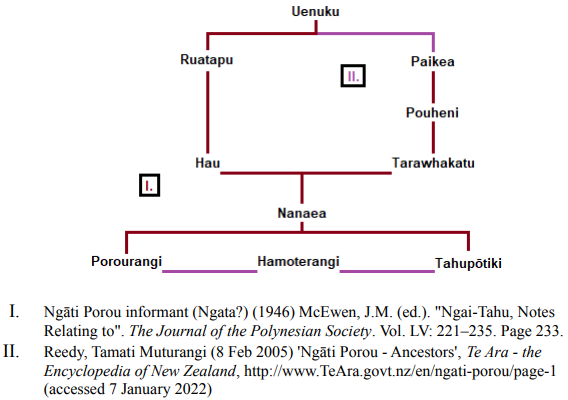
The progenitor of Kāi Tahu, Tahupōtiki, is considered by association with Paikea to be a relative of Porouariki (Porouariki Matataraawhare, te
tuhimāreikura o Rauru) the progenitor of Ngāti
Porou,[1][2] and to that
effect he is known to them as Tahupōtiki Te tuhimāreikura o Oho, a tamawahine.
Typically they are considered brothers.[3] Ngata said they inherited Toikairākau, Uenuku,
Kahutiaterangi, Paikea, and Ruatapu blood. Also in their traditions the progenitor of Ngāti
Kahungunu is the grandson of Porouariki.[4]
One of Beattie’s informants (1915) described Kāi Tahu and ‘Kati-Porou-raki or Kati
Kahukunu’ as being connected.[5]
In Kāi Tahu traditions
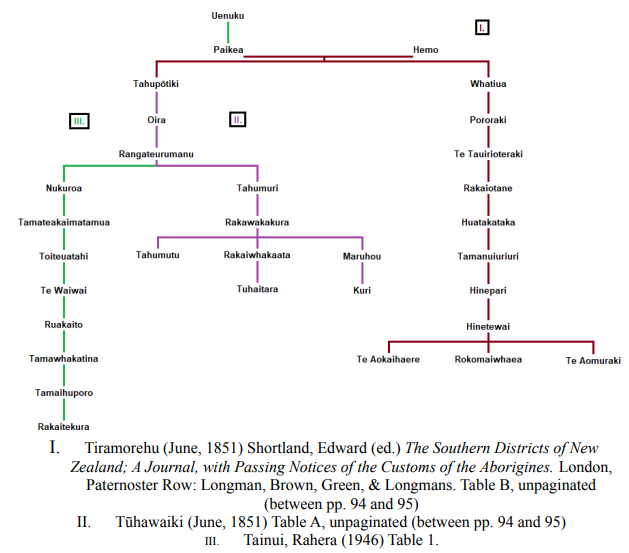
Tūhawaiki (1851) named a child of Tahupōtiki’s as Oira, and stated that he lived at Tūranga,
calling it ‘Turanga-nui-a-rua’.[6] Te Mamaru (1894) also listed Oira, and noted that
Tukumoana, Te Aomataki, and Pakea’s lines branched from Uenuku-horea.[7]
Tūhawaiki (1851) and Te Mamaru (1894) name Rangateurumanu as Oira’s child.[11]
Tainui listed Rakaitehurumanu as Iratahu’s child.
Tau (2005) listed Rakatehurumanu as IraaTahu and Iwi’s child. He married Matiheraki.
Sciascia (2012) listed Rakatehurumanu as IraaTahu and Huiarei’s child. He married
Matiheraki.[12]
All sources list Tahumuri as the child after that, however Tainui adds Nukuroa as an older
sibling, and Tau gives Marutai as Tahumuri’s spouse. Rakaitekura, the conclusion of Tainui’s
Nukuroa line, is the one who married Te Aohikuraki.
Rakawahakura
Tahumuri’s child is Rakawakakura (‘i heke mai i Turaka’),[13] or Rakaiwakakura,[14] or
Rakawahakura.[15] Several old men (Beattie 1922) referred to him as a leader of
Kāti Kurī.
He was later killed near Waikato.[16]
Rakawahakura is an ancestor shared with Ngāi Tāmanuhiri[17] Wordpress sources say that the iwi was
formerly known as Ngāi Tahu, and then Ngāi Tahupo, as they are descendants of Tahunui,
also called Tahupōtiki, or Tahumatua.[18]
Te Whataroa
Owing to growing tensions between the iwi inhabiting Gisborne District, many groups began
their migration away from Waerenga-a-Hika. An early instance of tension was when
Rākaihikuroa, grandson of Kahungunu, killed his own twin brothers out of jealousy, and was
banished after his own son Tupurupuru was killed in revenge.
Following that, local Turaka chief Tūtekohi invited Rākaihikuroa's other son Rākaipaaka to
his pā only to feed the prepared feast to his kurī, Kauerehuanui. This was an insult
Rākaipaaka, who showed no reaction at the time. After leaving, Whaitiripoto instructed
Whakaruru-a-Nuku to go back and eat the kurī in revenge. War thus broke out against the
Takutai-o-te-rangi pā and her allies.[19]
A particular engagement occurred with Kāi Tahu, involving Rakawahakura, Whaitiripoto,
and Whakaruru-a-Nuku.[20][21] Kāi Tahu sent a party out to visit the people of Turaka, and while
there the youths were playing games which the elderly joined in. One visitor, Maiwerohia,
would bring his opposing playmate out of sight and murder him, one man after the other until
the elders began to question where their young men were disappearing to.[22]
Kāi Tahu then invited them to a feast for which the fish and birds were actually cleverly
carved chunks of wood, designed to give the impression of those foods being prepared in the
storehouse, and it is for this reason that the battle is called Te Whataroa. The children began
playing games, enticing the adults to join in as a distraction while the hosts began to form
their attack, even killing the visitors' kurī before turning on the guests and cooking them in
the already-lit umu.
Tūtekohi ultimately won the war, and so Kāi Tahu was forced to move further down
Aotearoa.
Beattie's sources (1922) reported a ‘Kāti Kurī song’ composed while the iwi was still on
Aotearoa. It was printed as follows:
Text:
Beattie's informants explained the allusions:
Nau mai tunu ta ua e hine i kune
Whaka roko ake ai ki tou matua e
Taka mai waho nei e
Te kai taka roa mai a Te Uru-kotia
Tenei koa te whare a Taka-mai-i-roto
Ko te kai takaroa a Te-uru-kotia
I rapu haere e tau tahunga ki te mapara
Ka mate i reira kohatu-toa
Kohatutoa was a chief who was killed there
Ka rere a manu mai
Manumai was a chief who fled
I ra ka toatoa i roto i te auahi o te ahi
Rakatoatoa escaped in the midst of the smoke—he was the only one who escaped
Ka ea hoki ia i o tipuna
Koia te kai whakatari i a Whaitiri poto nei |
sent out as a spy by Whaitiripotonei the head chief,
Whakaruru a nuku a Ta-manuhiri
was Whakaruru the son of Nuku and Ta-manuhiri
A Rakawahakura i te wawa a Kaha
Rakawahakura was a well-known Kati-Kuri leader, wawa is the north-west wind
Waka mai i ra i Tawhiti
Tawhiti and Turaka are places near Gisborne
Koia te whata roa i tukutuku
Te Whataroa means the long stage for suspending food on, and that is the name given to that fight.
^Traditions and legends. Anonymous (1915) Beattie, H. (ed). The Journal of the Polynesian Society. Vol. XXIV:
page 133.
^Tūhawaiki (June, 1851) Shortland, Edward (ed.).The Southern Districts of New
Zealand; A Journal, with Passing Notices of the Customs of the Aborigines. Paternoster Row: Longman, Brown, Green, & Longmans. Table B, unpaginated
(between pp. 94 and 95).