Kāti Māmoe
Kāti Māmoe is an iwi said to have originally come from the Heretaunga (Hastings) area and moved down to Te Wāhipounamu just prior to Kāi Tahu’s migration into that area. Shortland (1851) reported having difficulty learning of Kāti Māmoe history as they were widely neglected in favour of the ‘more honourable’ iwi which was Kāi Tahu.[1]
Apparently, “Often those who claimed direct descent from Whatiua and Porouraki were also labelled as Kāti Māmoe although there was no obvious descent from Hotu Māmoe.” Every tribal group in Wāhipounamu before Kāi Tahu was called Kāti Māmoe,[2] evidenced when Shortland describes Kāti Māmoe as possessing ownership over the Arahura and its pounamu[3] when typically Kāti Wairaki are credited as the original owners.
While there is no distinct organisation of Kāti Māmoe today, many Kāi Tahu have Kāti Māmoe ancestry or in fact only had Kāti Māmoe ancestors prior to the arrival of the British. 3,111 people in New Zealand, or roughly 2 percent of the total population of Māori descent, affiliated with Kāti Māmoe in the 2018 census.
Origins
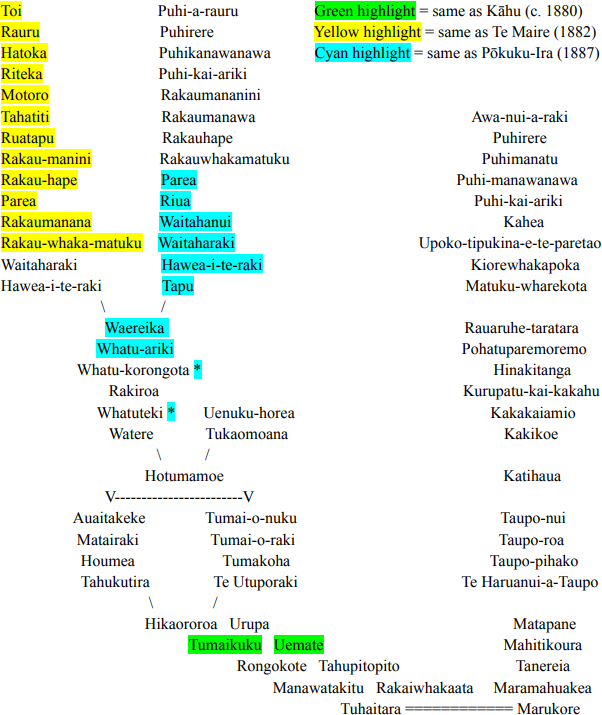
Hoani Kāhu - c. 1880
It is conceivable that this whakapapa (right) is elongated with sequences using the root names of remembered ancestors - this is a symbolic way to describe an evolution of the figure whose name is the root word. It is indeed poetic, informative, important knowledge in its own right, but is unlikely to represent a literal line of descent.
For instance, in 1849 Abraham Taonui gave a Ngā Puhi whakapapa stating the names before Rahiri were ‘tapu removers’ and not real men, indicating they were symbolic references and not historical figures.[4]
Notwithstanding recording and interpretation errors, the unique occurrences of names are…
Tawake
A figure in Ngāi Tāmanuhiri history is Tawakewhakato, who was the first husband of Tāmanuhiri's second wife Hinenui.[5][6]
A hapū of Ngāpuhi is Ngāi Tawake, descendants of Tawakehaunga,[7] their marae is in the Mataraua valley.[8]
Tawake is used as a name for the rare Fiordland crested penguin, Eudyptes pachyrhynchus,[9] while maire tawake is swamp maire, Syzygium maire.[10] ‘Kāhui Tawake’ were recorded by Beattie (1841),[11] which Prendergast-Tarena (2008) interpreted as ‘a cluster of birds’ alongside other Kāhui groups which also seem to represent natural phenomena.[12]
Te Maarapaoa
Macrons were not standardised in the 1800s, but Kāhu only appears to write double vowels when a second word begins, so the name is Te Ma-arapaoa, not considering macrons. Every occurrence of ‘ma’ has the ‘a’ macronised according to the list provided by Te Aka Māori-English Dictionary and Index.[13] The name might then become Te Mā-arapaoa.
Arapaoa (formerly Arapawa) is an island in the Marlborough Sounds, so we know this is a word, and to break it up into the next largest possible words we get Ara-paoa. The ancestor’s name might then be pronounced as Te Mā-ara-paoa.
Uemate and Tumaikuku
Te Mamaru (1894) placed Tumaikuku as a descendant of Hotumāmoe rather than an ancestor as Kāhu (c. 1880) does. Uemate is consistently listed as the spouse and in the former as a series of ‘Tumai’ occurring as male ancestors of Marukore in Te Mamaru’s version. The only other consistency is an unclear whakapapa association between Hotumāmoe and Tumai(kuku).
K. Ko Tumaikuku ka moe ia Irakukuru, ka puta ki waho ko Tukake-mauka raua ko te Whatu-kai-papaai, i mate uri kore raua i te parekura i Rauwhata. No muri ka moe a Tumaikuku i a Uemate, ka puta ki waho ko Rokokote, ka moe ia Tahupitopito, tana ko tana kahui Manawa tokotoru—i noho noho anake i a Rakaiwhakaata.
K. Tumaikuku dwelt with Irakukuru, and there were born to them Tukake-maunga and Te Whatu-kai-papaai, who both died at the battle of Rauwhatu without issue. Subsequently Tumaikuku dwelt with Uemate, who had Rongokote, who dwelt with Tahupitopito, who had a family of three, each named Manawa, who all married Rakaiwhakaata.
Rakau
The root word in Kāhu’s manuscript is otherwise ‘Raki’, but in Te Maire’s whakapapa (1882) 'Te Rakauwhakamatuke' occurs in a sequence of ‘Rakau’, which is noticeably similar to Kāhu’s 'Te Rakiwhakamatuku'. The former occurs again in Te Mamaru (1894) as 'Rakau-whaka-matuku' and 'Rakauwhakamatuku'.
Roko
Roko, appearing as a long sequence in Kāhu’s manuscript, is more than likely to represent Rongo in the northern dialect. Rongo or Roko is well-known as an atua of kūmara production, although there are other legends where Rongo is the name of a group of people who represent the crop - such as Te Kāhui Roko. In each case there is a contrasting entity, such as Haumia, representing uncultivated food.
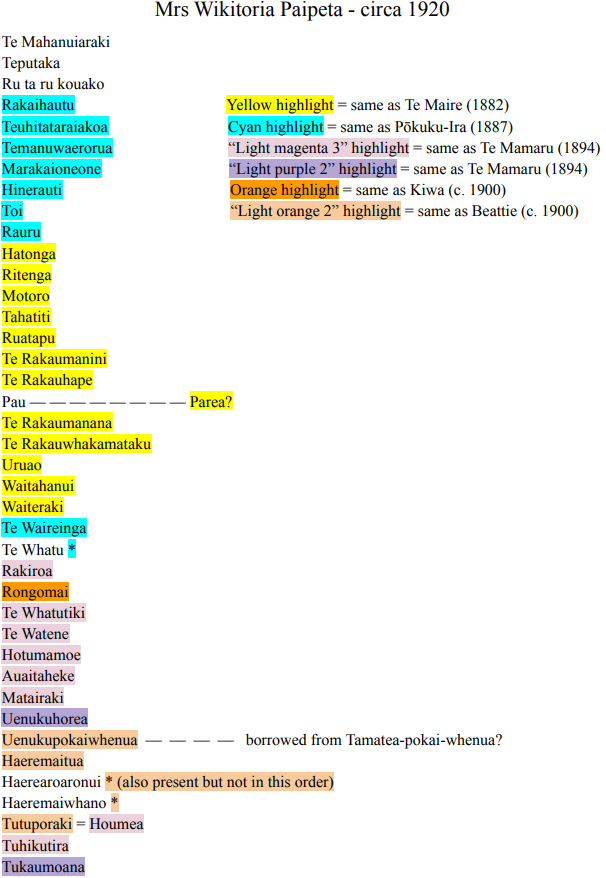
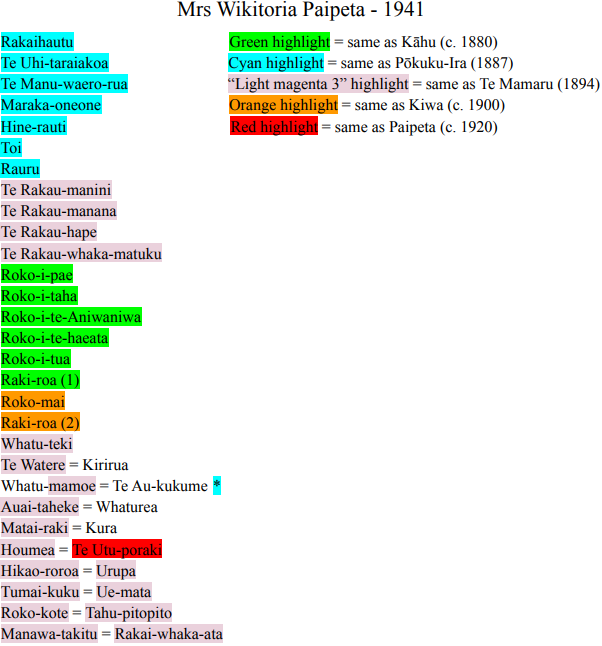
The idea of a sequence in Roko’s evolution appears again in a short whakapapa given by Mrs Victoria Paipeta, and it occurs in exactly the same list as it does in Kāhu’s manuscript:
| Na Te Kahui Tipua | From the Kāhui Tipua |
| , | |
| Na Te Ngahui Rongo | From the Kāhui Rongo came |
| Ia Rongopae | Rongo cast ashore |
| Ia Rongo taha | Rongo of the edge |
| Ia Rongo te aniwaniwa | | Rongo of the rainbow |
| Ia Te Rongo i te haeata | | Rongo of the dawn |
| Ia Rongo i tua | Rongo of beyond |
Additionally, this pattern is found in many standard creation whakapapa detailing the eventual creation and appearance of the primordial parents, describing darkness and light evolving through different stages, ‘like a tree growing from a seed’.[14]
Rakiroa
It is not uncommon for people throughout time, even today, to borrow the name of Raki or Rangi, the Sky Father, who is known throughout Polynesia. As the name occurs so far back in time however and the name is Raki-roa (long-sky) then this must be noted, especially as it appears right at the end of the Roko sequence.
Te Nuku
A most familiar association of the word nuku is perhaps used in the Earth Mother’s full name, Papatūānuku, the Earth separated from the sky. Noting the above sections, this may or may not mean anything significant.
Hotumāmoe
Hotumāmoe is said to have lived in the Heretaunga District.[15] Percy Smith added a note to Te Mamaru's whakapapa, 1894:[16]
F. Hotu-mamoe; the author adds opposite his name, “Ko Kati-mamoe tenei.” This is Ngati-mamoe, or from this man the ancient tribe of Ngati-mamoe take their name.
Te Mamaru - 1894
Alongside his whakapapa, Mamaru (1894) wrote…
C. … Rauru; i a ia ka puhi, e kiia nei ka Kingi o namata, koia a Puhi-a-rauru. Ko ka tangata tapu enei o namata kei roto i ka whare whakairo e noho ana. Ka putake tenei o ka taahu rangatira o te takata. Ko ka iwi ko Kai-tahu, ko Kati-mamoe, ko Kati-waitaha.
C. … Rauru; he possessed the puhi (or plumes?), which are said to be the kings of old, hence Puhi-a-rauru. These were the sacred men of old, who lived in the carved houses. They are the origin of the noble lines (of descent) of man. The tribes are: Ngai-tahu, Ngati-mamoe, and Ngati-waitaha.
If taken at face-value, this would imply that Tahupōtiki, Hotumāmoe, and Waitaha are already distant cousins descended from ‘Puhi’.
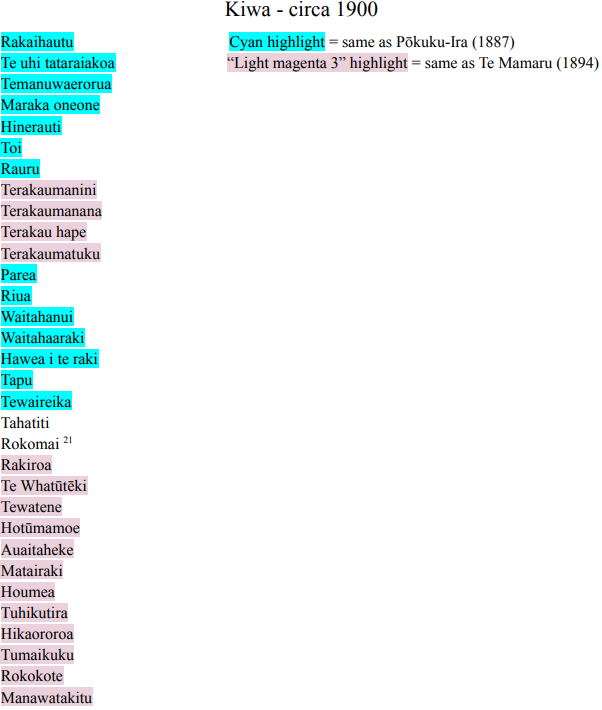
Kiwa - circa 1900
Mrs Victoria Paipeta - 1920
Victoria Paipeta - 1941
P.D. Garven - 1997
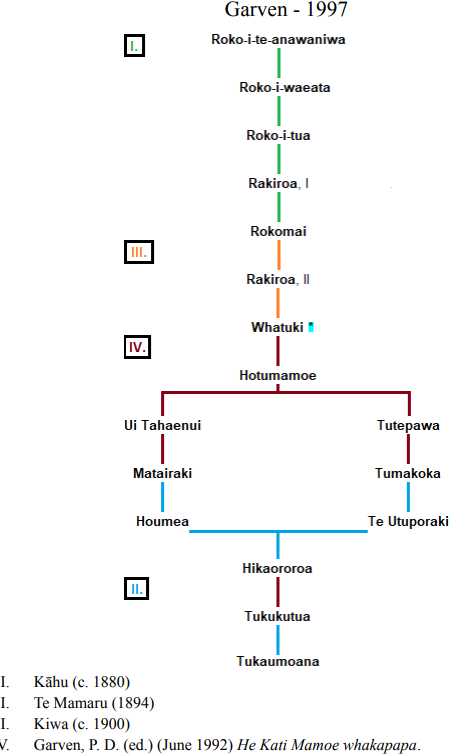
Compared to earlier iterations, Hikaororoa is placed one generation closer to Hotumamoe. With the addition and removal of certain individuals it is clear that Garven had access to additional sources, but also that most of his whakapapa has been copied from Beattie’s (1841) informants such as Mrs Wikitoria Paipeta, given the similarity to other whakapapa before her. His compilation stretches into the past and future much further than what should reasonably be shown here, but it is an exceedingly long compendium of these and other whakapapa.
Waitaha mythos
Most people think of Waitaha as an ancient iwi, or collection of iwi, who lived on Te Wahipounamu and were amalgamated by later arrivals from Aotearoa such as Kāti Māmoe. Some people might think of them as a different ethnicity altogether, perhaps as part of an elaborate theory connecting them to Egypt, South America, and Iran.
Te Maihāroa
(Hipa) Te Maihāroa was a Kāti Huirapa prophet who arose in the 1870s as the leader and teacher in Waitaha lore. He was never a student in any whare wānanga, but established his own school of learning with his teachings preserved in the manuscripts of disciples and his descendants such as Wikitoria Paipeta. He passed away about 1885-86.
The bulk of traditions concerning the Waitaha people and Rākaihautū have been passed down from Te Maihāroa. By 1857 he professed himself as an Anglican, although he was influenced by Kaingārara in the 1860s and under the teacher Piripi he became a tohuka, setting up a whare wānanga at Te Ao Mārama up the Waitaki about 1877.[17] Early informants of Rākaihautū traditions had either attended Te Maihāroa's whare wānanga, such as Wī Pōkuku and Herewini Ira (Eli), or were his descendants.[18]
See also: Te Maiharoa, Kelli (September 2019) Kā Pākihi kā Whakatekateka a Waitaha: The Plains Where the Waitaha Strutted Proudly, a thesis submitted for the degree of Doctor of Philosophy at the University of Otago Te Whare Wānaka o Otāgo Dunedin, New Zealand
Pōkuku - 1880
The earliest recorded account of Rākaihautū is from Wī Pōkuku in 1880, and is the earliest to name the lakes and rivers that were dug: Takapō (Tekapo), Pūkaki, Ōhou, Hāwea, Wānaka, Fresh-water (Lake) Whakatipu, Salt-water-Whakatipu (Whakatipu Waitī), Te Anau, and Waiau. At the end of the island he left the guardians Notī and Notā. After, he returned via Te Roto-nui-a-Whatu (Tuakitoto), Maranuku, (Te) Waihora, Taiari, Kaikarae (Kaikorai), Wainono, Ōkahu (Otaio), Te Aitarakihi (near Washdyke), Waihora, and Wairewa, and named his kō as Tuhiraki.[19] Thus, says Pōkuku, people say of those waterways 'Kā puna karikari a Rākaihautū.' ('The pools dug out by Rākaihautū.')
'Kā poupou a Te Rakihouia' ('Te Rakihouia’s upright posts') is also said about weirs used to catch hao (short-finned eels), tuna (longfin eels) and kanakana (pouched lampreys), hence the saying 'te hao te kai a te aitaka a Tapu-iti.' ('mud eels are the food of the descendants of Tapu-iti.')
The final saying is 'Kā pākihi whakatekateka a Waitaha' ('The plains where Waitaha walked proudly along'); as Pōkuku explained, "Rākaihautū was the man, and Te Rakihouia, and Waitaha were the iwi."[20]
Rāwiri Te Maire - 1882
Te Maire was a student of Te Maihāroa. This whakapapa was recorded by Judge F.R. Chapman.
- Toi
- Rauru
- Hatoka
- Ritenga
- Matoro
- Tahatiti
- Ruatapu
- Rakaumanini
- Rakauhape
- Parea
- Te Rakaumanana
- Te Rakauwhakamatuke
- Uruao
- Waitahanui
- Waitaharaki
Toi
Toi is a well-known name. The ‘Rarotongan teacher’ Matatia in 1842 gave Reverend Stair a genealogy which roughly follows the same initial line of descent as Te Maire’s 1882 whakapapa, though adding one name between Toi and Rauru[21] and apparently alternating between Samoan and Rarotongan names…[22]
- 63. O le Alii.
- 64. O le Ta.
- 65. O le Tai.
- 66. O le Rika-langi.
- 67. O le Ra-ulu.
- 68. O le Atonga
- 69. O le Te-alutanga-nuku (Tui A'ana).
- 70. O le Te-alutanga-langi (his son)
In Murihiku Toi was part of a tradition recorded no later than about 1852 by Reverend J.F.H. Wohlers. The account, translated and published by Christine Tremewan in 2004, focuses on the origins of the kūmara.
In the account Toi lives in the Kāhui Tupu (Te Kāhui Tipua) village, on Aotearoa. Roko-i-tua arrives from Hawaiki after knocking down the kūmara drying houses of Te Kāhui Roko. Te Kāhui Tupu ate tī kōuka (Cordyline australis), rārahu (Pteridium esculentum), and hīnau, (Elaeocarpus dentatus) and were amazed when Roko-i-tua excreted in the morning and his faeces came out looking smooth.
Roko-i-tua assisted Te Kāhui Tupu in making two waka out of a tree, one being Ārai-te-uru and the other being Mānuka. With these waka he travels with the Kāhui Tupu to Hawaiki and they retrieved cultivated food and instructions for how to grow it. At the end of the account he ascends to the sky and thus becomes Roko-tike.
The contrasts here are obvious; Te Kāhui Tupu represent the contrasting force to Roko and his people, Te Kāhui Roko - they are the wild, native, bitter foods of the land (thus eating only such things as tī and hīnau) while Roko and his people can produce sweet and cultivated foods. Ngāti Porou traditions provide the same base idea, except naming Roko-i-tua as Rongo-i-Amo.
Additionally, Beattie (1941) gave the names of many ancient tribes known to the elders of his time, such as the Kāhui Maunga, Kāhui Tara, Kāhui Ru, Kāhui Rangi, Kāhui Tawake, Kāhui Rua, Kāhui Ao, and Kāhui Toka.[23] Every ‘Kāhui’ mentioned relates to natural phenomena - thus ‘Kāhui’ were environmental pre-Māori ‘beings’, but not humans.
A vastly different Te Arawa legend involving Toi was published by Governor Grey in 1854.[24] Uenuku became annoyed with a dog and killed it, after which Toi-te-huatahi consumed its body. Tamatekapua and his brother Whakatūria, sons of Houmai, heard the dog barking inside Toi's belly. In revenge, they created stilts for Tama (the taller of the brothers) and stole the fruit from Uenuku's poroporo tree.[25][26] Uenuku declared war, and with Toi he attacked the village of Houmai, but the forces of Uenuku were ultimately defeated.[27] After the war, migration canoes were sent out to New Zealand.[28]
In an Aotea tradition also published by Grey (1854), Uenuku calmly threatened that he would feed his son's murderers to Toi-te-huatahi. This is part of another migration narrative, where the murderers flee to New Zealand.[29]
On transplanting, Prendergast-Tarena (2008) notes how late into the century that Te Maire provided information to his informants, noting how it is possible that some of his information (and others') has been adapted to 'gel' with narratives from elsewhere.
Ra-ulu / Rauru
Another ancestor from the Northland and Bay of Plenty regions, who also appeared in Matatia’s genealogical table as ‘Ra-ulu’. His name is lent to the Ngā Rauru, or Ngā Rauru Kītahi, of the Waitōtara-Whanganui area.
Atonga / Whātonga / Hatoka
Another ancestor from the Northland and Bay of Plenty regions, who also appeared in Matatia’s genealogical table as ‘Atonga’.
Ritenga / Riteka
Another ancestor from the Northland and Bay of Plenty regions.
Matoro / Motoro
Apparently more widely considered the father of Tangihia.[30]
Tahatiti
Tahatiti is apparently Tangihia of Rarotonga, Cook Islands.[31]
Ruatapu
An ancestor from the east coast of Aotearoa, from where Kāi Tahu originated. Listed in this context as a parent to Rakaumanini.
Parea
An ancestor from Aotearoa. Listed in this context as a child of Rakauhape and a parent of Te Rakaumanana.
Uruao
A waka known to have carried the Waitaha over to New Zealand according to Pōkuku-Eli (1887), here used symbolically to show that Waitaha are ‘descended’ or ‘from’ the waka.
Prendergast-Tarena (2008) notes a possible connection between Uruao and ‘uruzo’ from a Te Arawa proverb, “No te uruzo he Arawa koe.”[32] Prendergast-Tarena admits it to be a stretch, with no reason to assume the two words to be related and the true spelling of ‘uruzo’ to not have been recorded faithfully.[33]
Waitaha
Waitaha here appears in a short sequence as Waitaha-nui and Waitaha-raki.
Te Arawa tribes also have an ancestor named Waitaha or Waitaha-nui-a-Hei – Waitaha is the son of Hei, an ancestor aboard Te Arawa during the migration to Aotearoa after the war against Uenuku and Toi.
In regards to recording Kāi Tahu’s Waitaha traditions, Te Maire was only just beaten by Wī Pōkuku (1880), who was the first to write of the Waitaha-Uruao-Rākaihautū connection.
Nātanahira Waruwarutū (1886) wrote that Puhirere was the ancestor of Ngāi Te Waitaha, Ngāti Rapuwai, and Te Kāhui Tipua, describing Waitaha’s villages as Mairangi and Kāpukāriki which Ngāti Māmoe destroyed.[34] He made no mention of Rākaihautū or the Uruao. It is possible that Te Mamaru (1894) copied from Waruwarutū, making this idea of Puhirere as an ancestor to Ngāi Te Waitaha the most 'authentic' recorded version, and as Puhirere is a famous ancestor from the north this once again implies a transplant of Waitaha legends from Aotearoa to Te Wahipounamu.
Wī Pōkuku & Herewini Ira - 1887
In the Pōkuku-Ira manuscript, Waitaha arrived from Patunuioaio. Their waka were Huruhurumanu and Te Waka a Raki, captained by Te Moretu. Uruao lay in Taite Whenua. ‘Matahua’ was an incantation used upon Te Waka a Raki, and the god of Waitaha was Tukaitauru. Onboard was the adze Kā Pakitua. It beached at Aupouri in Northland before ascending into the skies, being associated with Autahi (Canopus), Takurua (Sirius), and Puaka (Rigel).[35]
In the next account, Matiti (ancestor and constellation) moved to the horizon to Patunuioaio, then moving to Tau Tarinui o Matariki (Pleiades), in the Kokota portion of the sky. The Uruao was sent to Rākaihautū, who along with Waitaha and the ‘deities’ Kāhui Tipua and Kāhui Roko departed for New Zealand. Toi and his son Rauru had also departed from that location. Tuwhakaroria was Rākaihautū’s kō which he used for digging lakes, and Matuarua was his god. Matiti fell on Aotearoa, that was occupied. Rākaihautū went to Te Wahipounamu where no people were, thus Rākaihautū ‘lit the fires of occupation’ on Te Wahipounamu, describing the concept of ahi kā.[36]
He is described as digging many of the same lakes along the coast and inland, leaving the same guardians, and renaming Tūwhakarōria to Tuhiraki. Another detail, "i riera [reira] ka toua te kauru, te aruhe (Pteridium esculentum), me ka manu me ka mea katoa ka tuturu tenei motu" ("It was also here that the roots of the cabbage tree and the fern-root can be found as well as the birds and all other things that pertain to this island"), emphasises the abundant food that could be found in the areas along the waterways.[37]
Comparison to Shortland
Shortland (c. 1840) collected a list of waka in his journeys around Te Wahipounamu, turning up these which are all shared with Aotearoa traditions: Takitimu, Makarewa, Mānuka, Arawa, Tainui, Te Mataatua, and Ārai Te Uru. It is immediately noticed how none of the ‘Waitaha waka’ are in Shortland’s list. Wohlers (c. 1850) was also given a narrative involving Mānuka and Ārai Te Uru.
Pōkuku and Ira's lateness could be explained by their traditions simply not being captured by earlier writers, however, this is unlikely as even later Kāi Tahu lore keepers such as Tūhawaiki would probably have had knowledge of any such pre-contact account; alternatively it is possible these traditions were constituted post-contact which would explain their late occurrence.
It is unlikely that European writers felt these traditions were somehow too ‘damning’ to record, especially in Shortland’s case as he showed an appreciation of Māori, and already recorded much in good faith from his informants such as Tūhawaiki and Tiramorehu (1851).
The natives of New Zealand differ essentially from those of all other Australian Colonies. … they are given to agricultural pursuits; and have been found to readily learn, and readily adopt, the more civilized practices of Europeans; at the same time that their bodily and mental organization is generally not inferior to our own. These advantages, added to their natural bravery and love of freedom, constitute them a class who must always have a political weight in their own country.
Multiculturalist racism
Some people insist that Māori were not the earliest inhabitants of New Zealand. For some of these, this is a way to 'claim' the islands as 'white person' space (although, even if Māori interbred with the young women of those supposed 'mysterious white people', they would still carry their DNA rather than would any European post-1769, who would only share a distant ancestry with these 'ancient white people' and thus also a distant cousinship to Māori albeit leagues closer than what muh mainstream narrative already says).
Others who proclaim such things are simply gurus with nothing better to do, so they are probably not malicious, but they make infuriating and random connections to anywhere from Celts to Australian Aboriginal peoples to whatever.
Others still might tie Waitaha and the Moriori into the mix in any way shape or form, and literally dozens of variants on this 'multicultural' thing exist, some which clash and disagree with other alternative pseudo-historical theories, usually for a desired historical narrative.
Background
Theories on where Māori came from are as old as the arrival of the British. Cook and his crew not only marked the beginning of colonisation in the 1770s but were the first to compose what more or less became the currently-accepted model used by scholars, anthropologists, and archeologists today. He identified the Malayo-Polynesian (Austronesian) language family. They noted a seemingly common and comparatively recent settlement of that region, evidenced by the striking similarities in the physical appearance, customs, mythology, and especially languages of the Polynesian peoples, including Māori. He suggested that the Pacific Islands peoples had an origin lying far to the west, possibly in the ‘Malay’ region or the ‘East Indies’. Australia and South America were ruled out due to a lack of apparent similarities with the people living there.[38]
Thomas Kendall in 1797 suggested that Māori may have originated in Egypt. In the 1800s connections had been made between European languages and Sanskrit, leading to the discovery of the Indo-European language family. This excited English intellectuals so much so that they sought to find ancient Aryan influence in every culture. Tregear was perhaps the first to suggest Müller's 'Sanskrit-speaking Aryans in India' had influence on Polynesians and thus Māori. Tregear declared that reo Māori, mythology, and customs contained extensive evidence of Aryan-Indian heritage.[39]
Percy Smith and Elsdon Best perhaps expanded upon earlier theories of Aryan Māori the heaviest. Gabi Plumm in ‘Skeletons in the Cupboard’ cited Elsdon Best recording a legend from the Tuhoe tribe in which over 165 generations ago (3,500 years ago) there was a disastrous war in ‘a very hot country’, India, which forced a group of people to flee from an invading race of a more dark-skinned people. They say this war is described in the Mahābhārata. After fleeing, the people found ‘Tawhitiroa’ and ‘Tawhitinui’ before they entered Polynesia. This is considered evidence in support of modern theorists’ ideas of a worldwide migration, such that both ‘Tawhiti’ locations are thought to represent Central and South America, and actually reflects a stage in the evolution of such multicultural theories.The legend as presented in the documentary at least was edited and thus mangled to fit the narrative of Aryan migration. Similarly, by combining many traditions into one narrative, Smith gave us the hypothesis of the ‘Great fleet’, which is now widely discredited:[40]
Smith's account went as follows. In 750 CE the Polynesian explorer Kupe discovered an uninhabited New Zealand. Then in 1000–1100 CE, the Polynesian explorers Toi and Whātonga visited New Zealand, and found it inhabited by a primitive, nomadic people known as the Moriori. Finally, in 1350 CE a 'great fleet' of seven canoes – Aotea, Kurahaupō, Mataatua, Tainui, Tokomaru, Te Arawa and Tākitimu – all departed from the Tahitian region at the same time, bringing the people now known as Māori to New Zealand. These were advanced, warlike, agricultural tribes who destroyed the Moriori.
Tikao - before 1939
The arrival of writing and widespread publication granted Kāi Tahu increasing contact with Pākehā and other iwi, which may have influenced their accounts. This can be seen when one of Beattie’s principal informants, Teone Taare Tikao, introduces Io as the supreme Māori god.[41] Previously Io did not feature in Wahipounamu traditions and his mention was likely the result of Tikao’s interactions with Hoani Te Turi Whatahoro Jury, the primary source of Io traditions.
Tikao also refers to early tribes as 'Maoriori'; their descriptions were based on negative racial stereotypes and connotations derived from the British. He described Hawea as being ‘a very dark people with thick mops of curly hair, and strong white teeth’, suggesting that they came from South Africa and were the first to arrive on Te Wahipounamu. Waitaha were described as ‘not so dark’, having long straight hair, and arriving from the ‘West’.[42] ‘Te Rapuwai, or Rapuai,’ were described as the third race to live on Te Wahipounamu, having copper or ginger hair and being clumsy. He suggested that they ‘came from Fiji’ and were ‘not much good’.[43]
These racial characteristics were new to traditions featuring Rapuwai and Hawea, and before British arrival they were not considered different ethnicities but as sub-groupings within Waitaha. Tikao connected Rapuwai, Waitaha, Kāti Māmoe, and the Moriori as something dissimilar from Māori.[44]
Tikao’s compilation of traditions into one narrative follows a theme of systemisation which Percy Smith and Elsdon Best commenced, which can be seen in the now discredited ‘Great Fleet’ theory. It seems that Tikao internalised the popular theories at the time of a massive Aryan migration around the world, and the idea of a pre-Māori group represented by the Moriori, as expanded upon by Julius von Haast. A developing feedback loop where Europeans theorised Polynesian origins that Māori internalised and repeated them back thus ‘confirming’ the theories becomes evident.
Beattie - 1941
Beattie suggested that after invading Māori killed and enslaved the original Moriori, tiny remnants survived in the Tuhoe Mountains and on Te Wahipounamu, evolving on the latter motu into Kāti Māmoe and Rapuwai.[45]
The spiritual tradition of Barry Brailsford
Brailsford may be thought of as the origin of the new-age stage of evolution on multicultural Waitaha, at least outside of Kerry Bolton’s 1987 pamphlet insisting that a European race inhabited the country before Polynesians.[46] Brailsford aims to legitimise foreigner settlement in New Zealand by creating a mythology that incorporates Pākehā and makes the coloniser indigenous:
Walk tall. Remember the ancestors of the Nation came from many colours. Some were of red skin, others brown or white, but all knew the pain of the Darkness that swept the land, and stayed true to the Peace Child.
And know the taonga are given to all who live within sight of the mountains and wish to call this land home. You are the child of the new Nation.
Geoffrey Clark found it necessary to differentiate between Polynesians, especially Māori, who genuinely have traceable claims as descendants of ancient Waitaha ancestry, and the ‘Nation of Waitaha’, who oftentimes are not even Polynesian.[47]
In his book Songs of Waitaha, Brailsford portrays Waitaha as a peaceful pre-Māori race who arrived 2,000 years before Māori and were of multiracial origins including Polynesians, Africans, Asians, and Celts. Waitaha were so peaceful that they lived in harmony with the environment, with the source of Brailford’s claims allegedly coming from ancient knowledge hidden within stones and trees. He otherwise makes no references of any kind. He contrasts Māori as violent and warlike, wiping out Waitaha who he depicted as descending from Rongo Marae Roa while Māori were descended from ‘Tu Ma Tauenga’. Another example of a largely romanticised claim is that Io Mata Ngaro was the supreme deity of Waitaha, but Io was again never a figure in Waitaha traditions until the time Beattie published Tikao’s words.
A solid critique of the book would be time consuming. One feels as if one is reading the saga of the smurfs and their migration to the land of the hobbits. The writer could find little that could qualify as authentic tradition.
Kaimanawa Wall
A site frequently related as evidence of pre-Polynesian settlers is the Kaimanawa Wall, which some claim is a remnant of ancient human construction that Māori could not have built because they did not build with stone in such a way. It was popularised in 1996 when Brailsford claimed that 'Waitaha elders' said it was built before their own arrival 2,000 years ago, which means there was a race much more mysterious than the already-ancient Waitaha he claims to speak for. Several anthropologists and geologists have concluded the formation to be a natural ignimbrite outcrop formed 330,000 years ago.[48]
Furthermore a forum contributor, Steve Clougher, who worked as a stone wall builder around 2010, noted that the stones “have been laid in with remarkable inattention to the basic rules of building in stone … It is anathema to lay two courses such that there is a continuous crack, from one course to the next. This is called a ‘vertical joint’, and to the educated eye, a vertical joint is like listening to an orchestra with one horribly out-of-tune instrument. It sticks out from a great distance, and screams of amateur building.” He goes on to note that this point alone makes an expert look for two other things: “first, the quality of the rocks, [would] have been wasted; second, [there are] other indications of awkwardness”.[49]
A ground-penetrating radar scan of the area surrounding the formation confirmed that it is not part of a pyramid as the rock has no regularities or chambers for a depth of 12 metres, and no metal had been found nearby under a geomagnetic scan.
Skeletons in the Cupboard
Theorists claim that ancient Persians were exiled from Iran, sailing around southern Africa and landing in Peru, only to be chased out again to Rapa Nui with Hotu Matuꞌa being their leader, and then spreading out into the rest of Polynesia thus ending up with a pre-Māori group that had been chased half-way around the world to ultimately settle in New Zealand. ('Chased', because they literally keep being exiled and driven out of places according to the story). This hypothesis is found in the 2015 ‘Skeletons in the Cupboard’ documentary where it is discussed by USA-born Martin Doutré and Mrs Monica Matamua (12:42). It would surely be the only time in recorded history where such a large migration occurred and completely avoided a whole continent - that is, Africa. The documentary nowadays is referred to constantly by theorists, and is so well-known that it has had to be pulled from television for horrifically pseudo-historical claims.[50] It is a good place to start when learning about these theories as it is a focal point, an amalgamation, featuring a wide array of controversial authors such as Brailsford, Gary Cook, and Doutré who is the author of the Ancient Celtic New Zealand website.
In the first 30 minutes Waitaha are connected to Northland, Taranaki, Ngāti Hotu, patupaiarehe, and the aforementioned migration narrative. Doutré emphasised that the ‘w[h]aka blonde’ category which the ‘migrants’ fall under “are Māori, but they are a different lineage to Māori”. Some people featured in this documentary claiming to be Waitaha say that when the Māori arrived they were taught how to survive in New Zealand, and wiped out the Waitaha.[51] This echoes Brailsford's earlier idea of Waitaha being 'peaceful' and then being wiped out by Māori.
The narrator puts little or no effort into properly pronouncing any reo Māori words nor are they even always spelled correctly on screen (11:27). That in itself is not always bad but does go to show how little she and Marsh know of Māoritanga and tikanga, how little work they have put into understanding the culture that they want to talk about and suggest alternative histories on. There is also shown a photo of the burial from Mary Island, Hauroko, which is incorrectly labelled as being from Northland (45:17, 46:24). Seemingly this was collected from Noel Hilliam when he flips through photos of skeletons he claims were ground up for fertiliser because they were unrelated to and unwanted by local iwi (43:42).
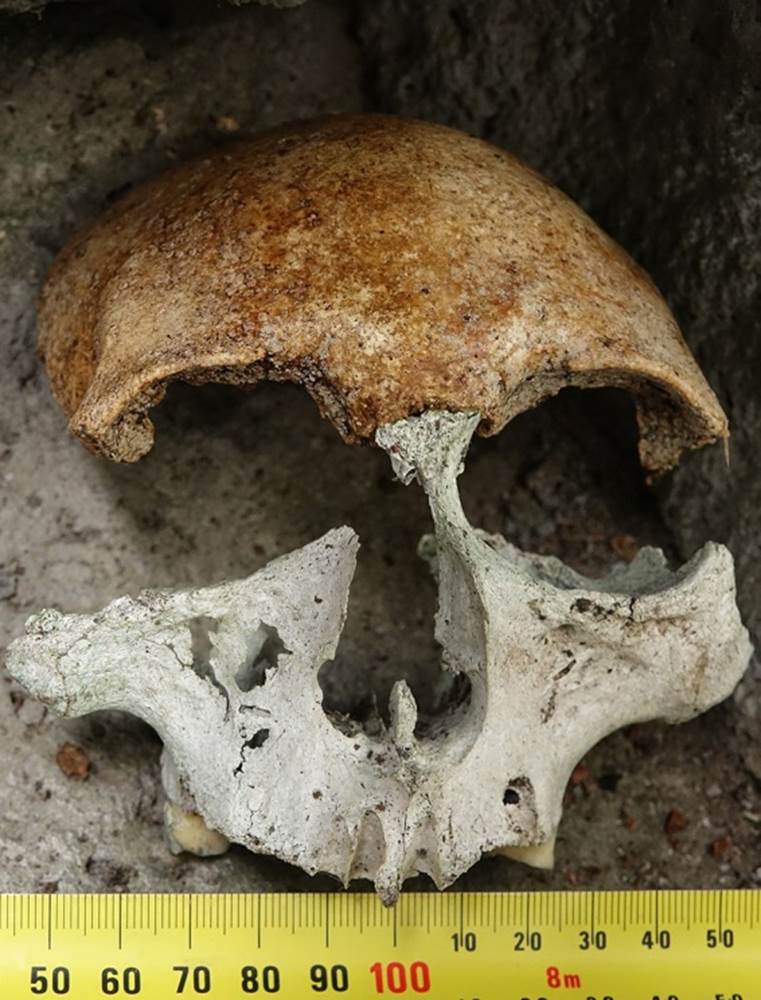
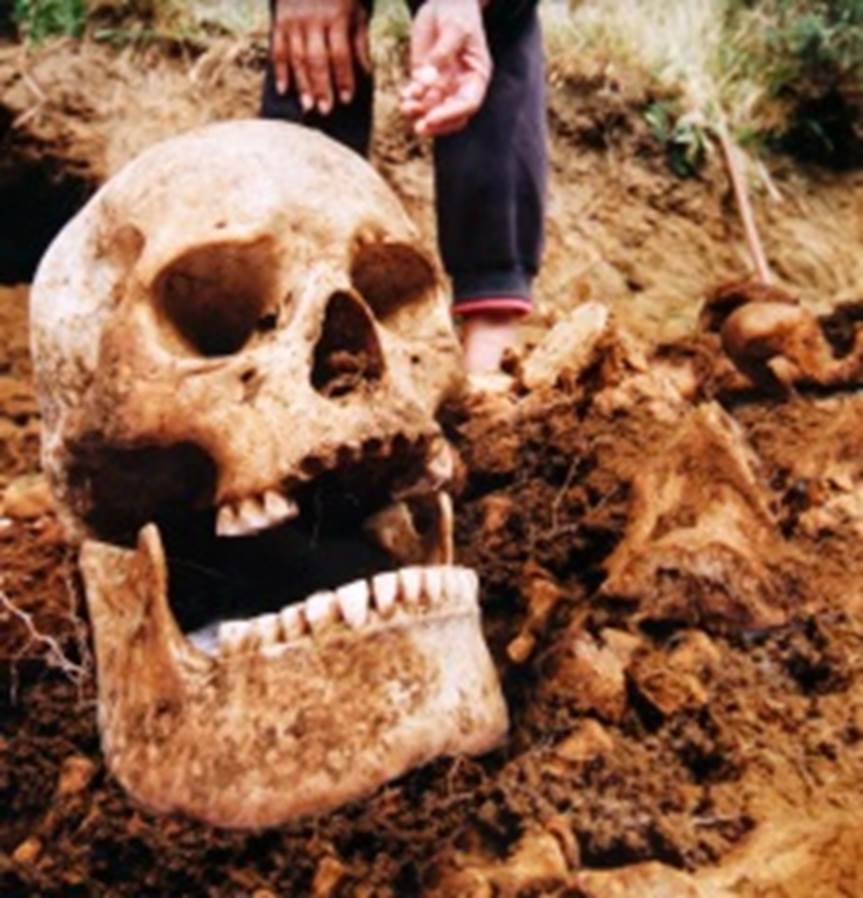
When Google Images is used to reverse-search the thumbnail (captioned as being from Raglan in the documentary), results include 2016 Stuff stories about skeletons found on the Waikato expressway and a washed-up skull on Raglan Beach. The expressway story has a video describing the process of what happens to excavated remains,[52] and the Raglan Beach story calls back to it, saying that those remains were estimated to be from the late 1700s.[53] This at least shows that skulls can get washed up on Raglan Beach, and that stories of such findings are reported. The thumbnail source can however be found on Ancient Celtic New Zealand, at ‘other ancient new zealand skull cranium types’. This page first discusses an investigation by Trevor Hosking, the ‘Tomo burial’ at Taupō-nui-a-Tia in 1966, written about in Alison Harrington (2007) A museum underfoot : the life story of Trevor Hosking, wherein is seemingly described ‘basketball shaped skulls [with] no eyebrow ridge’. Doutré suggests that this is typical for the Taupō region and bears no resemblance to ‘other Polynesian skulls’, referring to a photo of a ‘Ngāti Hotu skull as in the “coffin”’ at the top of the page (photo titled ‘MatthewWright_clip_image006_0000’). Doutré is apparently the earliest surviving source online that the image was uploaded to, without looking through archive websites. Google gives a date of 15/12/2003. The caption below says it was ‘taken in the vicinity of Waikato Heads’. It is titled ‘ MatthewWright_clip_image008_0000’. There is a ‘gifted and thoroughly respected historian in New Zealand with an array of historical books’ called Matthew Wright, but it is unclear if he or any 'Matthew Wright' is actually tangled up in these theories.
After being given a rundown on the patupaiarehe according to oral traditions, the viewer is asked why Māori unlike other Polynesians build raised houses for food storage, (14:41) implying that there was an outside influence for this ‘unexplained’ change in culture. If this was such a wild change, and the story of refugees travelling through Polynesia is the explanation for patupaiarehe, then why did they not leave other such buildings elsewhere in Polynesia if they are the influence? Why did they wait until New Zealand to give 'primitive' people the knowledge to raise buildings off the ground by a few feet?
The narrator (Gabi Plumm) 'investigates' the burrows at Te Koutu pā, on the shores of the lake Okataina (Te Moana i Kataina e Te Rangitakaroro), of Ngāi Tarawhai. According to archaeologists, these burrows were used as storage. Crawling out of one, Plumm makes a point of saying that one could easily sleep inside, that it could fit a whole family of people, but “not tall people”. The suggestion is that ‘short-statured pre-Arawa people’ used the burrows as hiding spaces. However, the rest of the documentary is dedicated to the migration theory and of people such as Mrs Matamua, with Plumm even commenting “they’re not mystical fairy folk of the forest at all”, which invalidates the small burrows being archeological evidence of small pre-Māori people, and renders the whole fuss over 'short people' completely meaningless.
In part two the documentary references Kāi Tahu oral traditions regarding an ancient people, Hawea, saying that they had ‘dark skin, curly hair, and skinny legs’, which the narrator associates with Australian Aboriginal peoples, as well as the Moriori of Rēkohu. This echoes Tikao, 1930s.
Matamua's DNA
Unfortunately, Mrs Monica Matamua took the first version of the National Geographic Genographic Survey DNA test, so those results would no longer be accessible to her as the survey has since closed. 2014 scientific methods to read, understand, and compare DNA are also outdated. Matamua claims to be one of roughly 2,000 living descendants of Ngāti Hotu (she is also Ngāti Maru, Ngāti Tūwharetoa, and Whanganui Māori), and more recently has claimed that the group's ancestors left Iran through Borneo,[54] which is in southern Asia, instead of going around Africa and through South America.
From the 2014 elocal magazine feature saved in a Facebook post, we know that her maternal haplogroup was identified as B4, and her regional results turned up 28% northeast Asian, 20% southeast Asian, 18% Oceanian, 12% northern European, 12% Mediterranean, 6% Sub-Saharan African, and 4% southwest Asian. Her reference populations were to Papuans, Vietnamese, and Puerto Ricans. Her highest match percentages were from Polynesia, the Americas, and Asia, with next to nothing from around Iran as Doutré otherwise claimed. Besides, the map is only a heatmap of B4's frequency in populations, so those distant cousins are related to Matamua maternally going back 50,000 years.
None of this actually means she has got, say, African DNA through ancient Māori connections. DNA estimates are always going to be muddly and never will be perfect, as they can only provide an estimate based on current scientific progress. They need reference populations to compare to for more accurate representations of a person's DNA so in Matamua's case, back in 2014, they had a really, really bad reference for Polynesians, and had to default to other, closer things. That is not even mentioning we the audience do not know her full autosomal ancestry, how much of it is actually European or other Pākehā.
There is no further detail given to refine Mrs Matamua's haplogroup beyond 'B4'. The descendant B2 is found in the Americas, so if Mrs Matamua had a maternal line of Amerindian ancestry, National Genographic would have been courteous enough to broadly allocate it as such. It is most likely that her maternal line as a Māori falls within the Polynesian motif, that is B4a1a1. Refer to Māori genetics for a visual depiction. Mrs Matamatua was correct to drop the Peru story and swap it out instead for Borneo, as that would at least make slightly more sense.
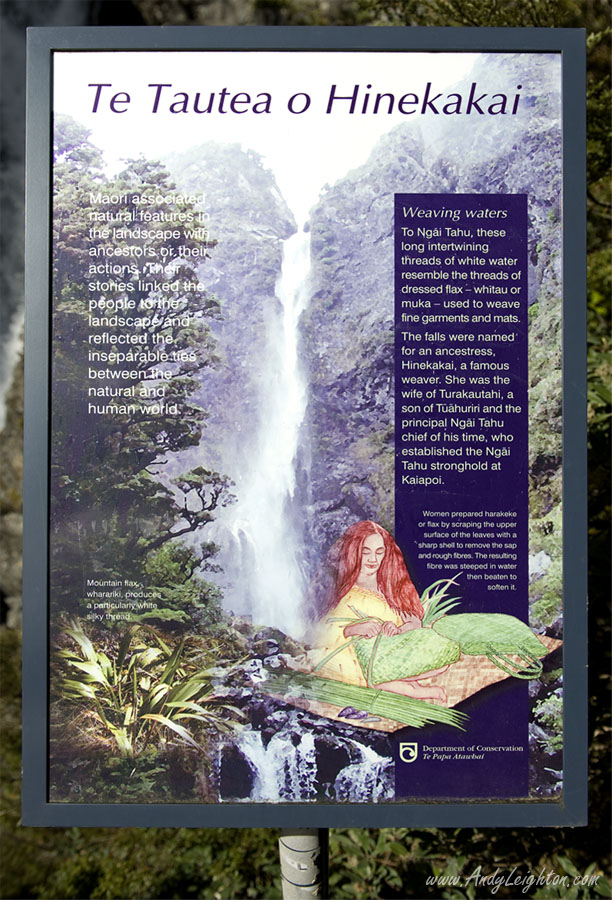
Hinekakai
Hinekakai is a notable ancestress for Kāi Tahu. Through her father Te Rakiwhakaputa she was Kāti Kurī, and through her mother Hineteawheka she was Kāti Māmoe.
I have guessed her birth as being about 1680 CE.
She is remembered as a legendary kairaraka or weaver, said to have scraped her kōrari or harakeke before drying it in front of a fire.[55]
Near the modern Arthurs Pass village there can be found a track which leads to the 'Devils Punchbowl Falls', which as named by our Kāi Tahu ancestors is called Te Tautea o Hinekakai, after this ancestress. The waterfall plunges from 131 metres high and the way that it 'weaves' around the boulders resembles finely-dressed and scraped kōrari (called muka or whītau) so fine that it is comparable to the work of Hinekakai.[56]
To practice the arts of raraka yourself, there has been compiled a page dedicated to weaving tutorials which can be found here.
Ka timu te tai, ka pao te tōrea, ka ina te harakeke a Hinekakai.
References
- ^ Shortland, Edward (June, 1851). The Southern Districts of New Zealand; A Journal, with Passing Notices of the Customs of the Aborigines. Paternoster Row: Longman, Brown, Green, & Longmans. Page 102.
- ^ Ellison, Megan (July 2009).
- ^ Shortland, Edward (June, 1851). Page 99.
- ^ Simmons, D. (1976) The Great New Zealand Myth. Wellington, A.H. & A.W. Reed.Simmons, 1976, page 39.
- ^ Korimuroa! An account of an obscure battle forgotten by everybody, that nobody cares about.
- ^ Walker, Te Ariki (2014). Nga Maunga Korero - Tamanuhiri and Hinenui
- ^ Kaikohe (Rau Marama) Community Trust "The Heart of Ngapuhi" Kaikohe.
- ^ Marae 'disappearing into the landscape' Roy, Eleanor Ainge (14 Aug 2011). Stuff.
- ^ Moorfield, John C (Copyright 2003-2022) /"tawake/", Te Aka Māori-English Dictionary and Index.
- ^ Moorfield, John C (Copyright 2003-2022) /"maire tawake/", Te Aka Māori-English Dictionary and Index.
- ^ Beattie, H. (1941) The Moriori of the South Island. Dunedin: Otago Daily Times and Witness Newspapers Ltd. Page 6.
- ^ Prendergast-Tarena, Eruera Ropata (2008) Page 184.
- ^ Moorfield, John C (Copyright 2003-2022) /"mā/", Te Aka MÄori-English Dictionary and Index.
- ^ Māori creation traditions - Common threads in creation stories Royal, Te Ahukaramū Charles. Te Ara - the Encyclopedia of New Zealand.
- ^ Ellison, Megan (July 2009).
- ^ Te Mamaru, T. R.; Smith, Percy (March 1894). Pages 14 and 15.
- ^ Te Maihāroa, Hipa Somerville, Ross.
- ^ Prendergast-Tarena, Eruera Ropata (2008)
- ^ Rākaihautū University of Canterbury
- ^ Orbell, Margaret An Account of Waitaha Origin, By Wī Pōkuku, pages 16–19 cited in Prendergast-Tarena (2008) pp. 269–270.
- ^ Floatsam and jetsam from the great ocean: or, summary of early Samoan voyages and settlement Stair, John B. (1895). The Journal of the Polynesian Society. Vol IV: pages 129–130.
- ^ History and traditions of the Taranaki coast: Chapter , Toi and his descendants (1907). The Journal of the Polynesian Society. Vol XVI No. 4: pages 175–187.
- ^ Beattie, H. (1941) Page 6.
- ^ First peoples in Maori tradition - Toitehuatahi Royal, Te Ahukaramū Charles (10 February 2015). Te Ara - the Encyclopedia of New Zealand.
- ^ Mitira, Tiaki Hikawera (1972) Takitimu.
- ^ Cowan, J. (1910) The breadfruit tree in Māori tradition, Journal of the Polynesian Society 19. Pages 94-96, via Māori plant use, Landcare Research
- ^ Tregear, Edward (1891) The Maori-Polynesian comparative dictionary. Wellington, New Zealand: Lyon and Blair. page 572.
- ^ Grey, George (1854) Polynesian Mythology and Ancient traditional History of the New Zealanders. Pages 92–93, 97
- ^ Grey, George (1854). Page 150.
- ^ History and traditions of the Taranaki coast: Chapter V, the canoes of 'The Fleet' (1907) The Journal of the Polynesian Society, Vol. XVI No. 4: page 199. Apparently cites Historical sketches of savage life in Polynesia; with illustrative clan songs by Dr. William Wyatt Gill, 1880.
- ^ Whakapapa – genealogy - Whakapapa with links to Polynesia Taonui, Rāwiri. Te Ara - the Encyclopedia of New Zealand.
- ^ Dieffenbach, Ernest (1843) Travels in New Zealand. London: John Murray, Vol II, page 85.
- ^ Prendergast-Tarena, Eruera Ropata (2008) page 254.
- ^ Whatahoro, J.T. (1886-1903) Ms 15, ATL 189-104, pages 60-73
- ^ Ko Te Pukapuka Whakaako ko te Korero Tipuna Wī Pōkuku and Herewini Eli (1887), unpaginated. Ngāi Tahu Māori Trust Board Archives
- ^ Tau, Te Maire (2003) Ngā Pikitūroa o Ngāi Tahu: The Oral Traditions of Ngāi Tahu. Pages 270–271.
- ^ Tau, Te Maire (2003) cited in Prendergast-Tarena (2008) pp. 271–272.
- ^ 1770s–1840s: early ideas Howe, K. R. (8 February 2005). Te Ara - the Encyclopedia of New Zealand.
- ^ 1840s–1930s: the Aryan theory Howe, K. R. (8 February 2005). Te Ara - the Encyclopedia of New Zealand.
- ^ 1840s–early 20th century Howe, K. R. (8 February 2005). Te Ara - the Encyclopedia of New Zealand.
- ^ Tīkao, Teone Taare. Herries, Beattie (ed.) (1939). Page 24
- ^ Tīkao, Teone Taare. Herries, Beattie (ed.) (1939). Page 17
- ^ Tīkao, Teone Taare. Herries, Beattie (ed.) (1939). Page 58
- ^ Tīkao, Teone Taare. Herries, Beattie (ed.) (1939). Page 101
- ^ Beattie, H. (1941). Page 7.
- ^ Kerry Bolton – a nut, or just a misunderstood Mormon/Satanist/Nazi? Barrie Sargeant (2 December 2004).
- ^ Identity and alternative versions of the past in New Zealand Clark, Geoffrey.
- ^ A New Age Myth: the Kaimanawa Wall Ritchie, Neville (1 November 1996). NZ Skeptics.
- ^ the Kaimanawa Wall structure, Lake Taupo - natural or man made? electrobleme (4 September 2010) quoting a Steve Clougher from 'mysteriousnewzealand.co.nz', Electric Universe forum - Everything Is Electric
- ^ TVNZ doco claiming Celts were here before Māori has been removed from OnDemand service Rose, Jeremy - 20 August 2018. Stuff.
- ^ Who was here before us? Greenstone TV. (2000).
- ^ Pre-European skull found at site of major Waikato expressway project Yalden, Phillipa (31 March 2016)
- ^ Human skull washes up on Raglan beach Greenstone TV. (2000).
- ^ One Woman's Battle for Recognition of Ngāti Hotu elocal (Digital ed.). May 2020. Pages 18–23.
- ^ Anderson, Atthol; Tau, Te Maire (eds.) (2008) Ngai Tahu: A Migration History; The Carrington Text. Page 135.
- ^ Photo by Andy Leighton Department of Conservation sign