Kōrari
Kupu
According to Lindsay (1868): "In Otago, the general name of the plant, as a whole, is Korari, or as metamorphosed by the settler pronounced and spelt Kouraeri, or Coradi."
Ray Harlow in the 1985 book A Word-list of South Island Maori shows raraka defined as 'weaving'. In institutionally-enforced reo Māori, the kupu would be raranga. This spelling was recorded by Rev. James Watkins in the early 1840s, at Waikouaiti. Harakeke is given, while korari is explained as 'a sweet fluid extracted from the flax'.
Kai- is a prefix to indicate human action, so a kairaraka is a weaver, and a kaiwhakapapa is a genealogist.
Creations
- Arapaki — ornamental lattice work
- Hipora — rough cape, coarse mat, 'rough basket for cooking tuna', and/or jute
- Hōpiro — 'small basket of kōrari or kiekie'
- Kāwhiu — 'basket used exclusively when diving for kina, pāua, and kuku. It has a wide mesh and a rope at the opening edge so that it can be closed when swimming back to shore.'
- Kete — basket or kit
- Kete whakairo — finely-woven, patterned kete, done by experts
- Kī — ball
- Kōaka — coarse mat, or a 'lingual modifier' to indicate that something is made of undressed kōrari
- Kōnae — 'small basket woven from flax', or the 'belly of a fishing net'
- Kono — 'small square basket for cooked food', or a noose, a knot, or a loop
- Kōrari — Trumpet made from the plant, also the stalk of the plant, and in some dialects the name of the entire plant
- Piri — 'closely woven protective mat used as a defence against spear thrusts' or 'woven flax foundation of a dogskin cloak'
- Pōrera — floor mat
- Pukupuku — 'shield - closely woven mat used for protection in battle'
- Rāhiri — rope
- Rahu — 'basket, made of strips of undressed flax for collecting food, etc'
- Raurau — container, basket
- Rawhi — basket
- Roroi — basket
- Rukuruku — small basket
- Taiaroa — basket
- Takapapa — tablecloth or cloth on which food is spread
- Takapau — floor mat or mattress
- Takapau wharanui — wide sleeping mat, chiefly marriage bed
- Takapou — floor mat
- Tātoru — three strand plaiting, rope or cord
- Tātua — belt
- Tātua kōtare — war belt, long band of harakeke worn around the body as armour
- Tātua pūpara — belt for valuables
- Taukaea — rope
- Tīenga — ornate sleeping mat of kiekie for ceremonial occasions
- Tukutuku — ornamental lattice work
- Tuwhara — coarse floor mat placed under finer mats
- Waikawa — coarse mat
- Whakarewarangi — floor mat of black and yellow harakeke strips
- Whāriki — floor covering, mat, carpet
- Whiri kawe — three strand rope
- Whiri papa — flat three strand rope
- Whiri pāraharaha — flat three strand rope
Dress
- Hieke — 'large coarse cloak of rough kōrari'
- Hipora — rough cape, coarse mat, 'rough basket for cooking tuna', and/or jute
- Kahu tāniko — 'cloak of fine flax with ornamental border'
- Kahu-koka — 'rough outer garment of undressed flax or kiekie leaves'
- Kākahu — catch-all for every item on this list and anything that counts as clothes or costumes
- Koka — old, brown, dry leaves, also a rough cape made of undressed leaves
- Mangaeka — a rain cape; rough outer garment of undressed kōrari
- Mangaeka-tātara — cape of undressed and undyed kōrari
- Maro — a type of short garment worn by males and females, sort of like a short kilt, loin cloth, or apron
- Maro whaiapu — 'superior maro', made with dressed kōrari
- Ngāeheehe — garment like a piupiu, made of undressed kōrari
- Pākē — 'rough cape made of undressed leaves of kiekie or harakeke'
- Piupiu — 'waist-to-knees garment made of' harakeke
- Pūreke — 'rough rain-cape, made of undressed harakeke'
- Tāpeka — sash, wide diagonal shoulder belt
- Tarahau — rough cloak of kiekie leaves
- Tihetihe — rough outer garment made of undressed harakeke
- Whaiapu — 'superior maro', made with dressed kōrari
Misc
- Haehae — tool for measuring and tearing leaves into whenu
- Hakihaki — worn out mat
- Houhere — Hoheria genus
- Hukahuka — 'thrum, tassel of two strands (e.g. of a korowai), fringe'
- Kākaho — 'culm, stem of toetoe - used for lining the walls of buildings and for making kites'
- Karu hāpuku — weaving pattern
- Kōrito — young unexpanded leaves
- Kiekie — Freycinetia banksii
- Kukakuka — scrapings from preparing muka
- kūkuta — Eleocharis sphacelata
- Kutakuta — Eleocharis sphacelata
- Māwhitiwhiti — crossover stitch
- Miro — Prumnopitys ferruginea
- Nana — Zostera
- Neinei — Dracophyllum latifolium
- Pā harakeke — bush of harakeke
- Parakoka — scrapings from preparing muka
- Pātangatanga — kiekie fruit
- Pātītī — Microlaena stipoides
- Pātītī taranui — Elymus solandri
- Pēia — Freycinetia banksii
- Pīngao — Desmoschoenus spiralis
- Pīrori — kiekie berries
- Pū harakeke — clump of harakeke
- Tāeo — thicket, of either kiekie or kareao
- Tāniko — finger weaving or a cloak border made by such
- Taritari āwhā — Dracophyllum latifolium
- Tāwhara — edible bracts of Freycinetia baueriana ssp. banksii
- Tēure — Freycinetia baueriana ssp. banksii berries
- Tī kōuka — Cordyline australis
- Tikumu — Celmisia spectabilis subsp. spectabilis
- Tīrori — kiekie berries
- Tōī — Cordyline indivisa
- Ureure — kiekie berries
- Whatu — finger weaving, fibre weaving
- Whatu aho pātahi — single weft twining
- Whatu aho rua — double weft twining
- Whauwhau — Hoheria glabrata
- Whenu — strand or strip of harakeke
- Whītau— fine fibre like muka
Introductions



Harvest
-
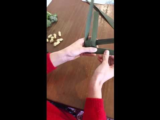
 How to harvest harakeke (12:02)
-
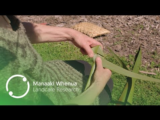
 Harvesting Harakeke (3:44)
-
 By Andrew Noble for Te Puawaitanga Ki Ōtautahi Trust (3:16)
-
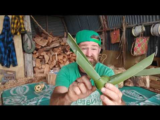
 Gathering flax (7:40)
-
 Harvesting harakeke with Te Ao (4:44)
According to Christchurch City Libraries, leaves must not be harvested when kōrari stalks are growing.